So if we can’t talk about God in a way that attempts to “prove” God exists, then how do we do it? How do we talk about and think about God?
If experiencing God is the ultimate experience any human being will ever have, how can we faithfully talk about what it was like? How can we do our jobs as human beings and make meaning out of our experience with God?
“Theology” is a word that literally means “talking about God.” But talking is hard, isn’t it? It’s hard to get across what we mean a lot of the time, isn’t it?
How many times have you been in a conversation, thinking the person you’re talking to is with you completely – is 100% understanding what you’re saying – only to learn later that they have not only not gotten the gist of your words, but they seems to have had the opposite interpretation than what you wanted? That happens to me a lot.
I think this happens because words are not real things..
Doesn’t it seem absurd to say that “words are not real things”? Can you think of the last time you consciously thought about what words are and how we use them? I can’t. I don’t live my life worried about whether when I say “I’d like a cup of coffee, please” that the person I’m talking to will not know what I mean. We both exist in a society that has agreed that when someone says “coffee” they mean that delicious brown liquid. But that’s the point: the word “coffee” is different than the brown liquid. “Coffee” is only a symbol for that brown liquid.
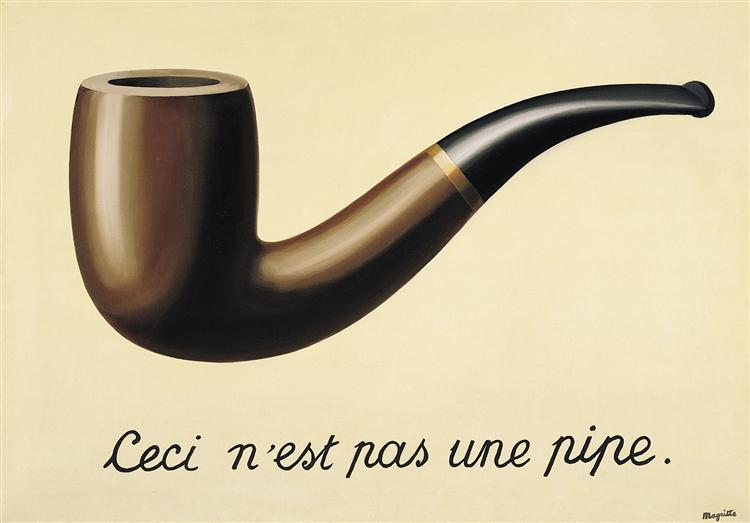
There is a famous painting, “The Treachery of Images,” by the Belgian surrealist René Magritte currently on display at the Los Angeles Museum of Art. It’s comprised of an image of a tobacco pipe with some text underneath. Translated from the French, it reads: “This is not a pipe.” Magritte’s intention with the piece is similar to the saying by philosopher Alfred Korzybski: “The map is not the territory.”
Both men teach us there is a difference between an object and any representation of, or reference to, the object. Just as a painting of a pipe is not a pipe, the word “coffee” is not actual coffee. This may sound like a silly exercise to you, but think about the implications when we move from physical objects to intangible ones.
Let’s say I tell you I’m sad and you say “I know exactly how you feel.” To be sure, there is a level at which your language is merely meant to communicate sympathy for me. I’m supposed to read nothing more into your words except that you want me to know I am not alone, someone else has endured sadness, and that you are here for me. Often, that is more than enough. Perhaps the heartache I am feeling is the ending of a relationship. You had one end a year ago. I saw your pain then, and I recognize my own experience is similar to what you went through. So when you say: “I know exactly how you feel,” I believe you.
But a dozen years ago my father-in-law took his own life. It was a painful experience more deep and profound than anything I’d ever known, and my experience didn’t hold a candle to that of my wife. After that day, when people tried to comfort us by saying they knew exactly how we felt, we were aware that there was a disconnect in an understanding of how the world works. They were using words to describe pain they had felt, but it was not, in any way, like the journey we were on. Words failed in those moments, because of course they did.
Our words fail us in the best of times, so, of course, they fail in the worst of times. When I think about the most severe arguments I’ve had with my wife, the common denominator is not that one of us has done something horrible. No, our fights are most often the result of a lack of communication and unexpressed expectation. I am amazed and embarrassed at the number of times we come out of a fight having discovered we did not disagree at all, and our entire conflict was a result of using different words to describe the same desire.
If it is that difficult to talk to another human being about something we are both experiencing right here, right now how can we possibly think we can talk to each other about God? Especially since we want and need to talk to one another about God. So how?
For today, let’s start here: Let’s acknowledge we have a hard enough time talking about physical things right in front of us, let alone intangible things like experiences. As we approach the “something more and beyond” we want to describe we should start by admitting it is impossible to literally describe it. We can’t use a mindset of “literalness.”
This is why I believe our “theological mindset” should be a symbolic mindset.


 PLGRM
PLGRM 
Leave a reply to James Wendelken Cancel reply