
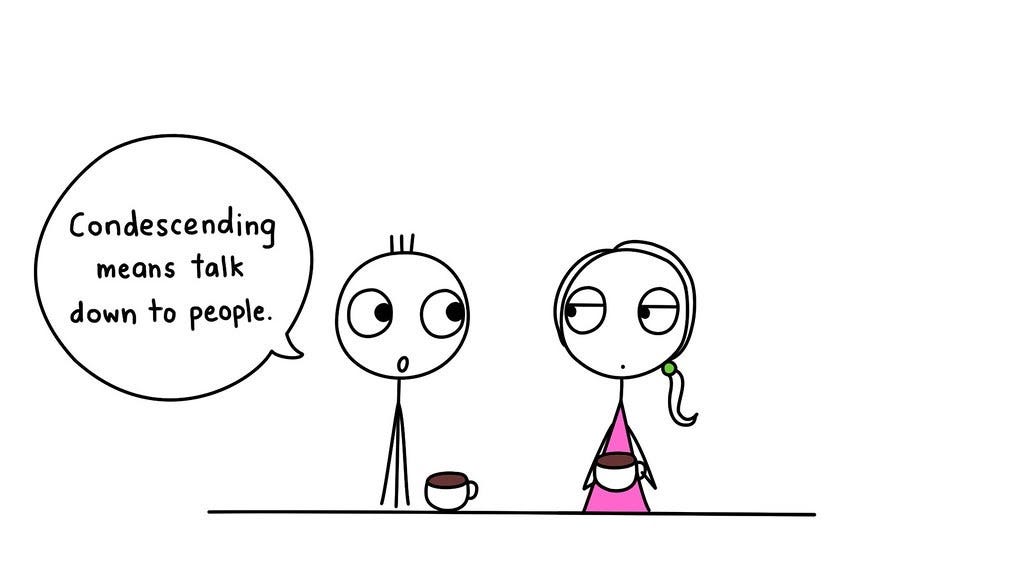
Here’s one of my favorite jokes:
“My friends all say I’m condescending. That means I talk down to people.”
I don’t know if people laugh at this joke when I tell it because it’s inherently funny or if they don’t have the guts to tell me it’s a little too much like me, but I think about this idea of “condescension” a lot. I think about it because I work very hard to not come off that way.
I’m a guy who likes to know things and to be intelligent and to not be dumb. I also feel like it’s important, when I’m in conversation with others, to make sure that the words we use are precise and that we’re talking about true information. Sometimes guesses are important, but I don’t particularly appreciate when people assert their guesses as fact. If the topic is important and warrants it, I usually push for a high degree of specificity when discussing and diagnosing a problem. The more specific we can get, I believe, the better decisions we can make.
This also explains my love of language. I like “big words” even though I don’t use them often. I have a friend who uses a lot of big words like he’s breathing. It just comes so natural to him, and even though the rest of our friend group pokes a little fun at him the truth is we’re all supremely jealous of his vocabulary. His ability to describe something with utmost precision is a talent that I wish more people (certainly myself) had.
There is, of course, a big different between being specific to make things clear and coming off as a know-it-all.
There are times when we want to help someone understand something, so we explain it in simpler terms that we might ordinarily do so. I think of Denzel Washington’s character in the movie Philadelphia when he repeatedly asks someone to “explain this to me like I’m a six year old.” The risk, of course, is that we might insult someone intelligence by “watering it down” when they are perfectly capable of understanding what we’re saying.
Of course, it’s just as likely we will insult them in the opposite direction, too. I’ve had too may instances where I’ve explained something to someone and, afterwards, they accused me of acting snotty and trying to make myself out to be smarter than them.
The truth is: Sometimes we want someone to be condescending to us and sometimes we don’t.
Likewise: Sometimes we need someone to be condescending to us and sometimes we don’t.
The 16th Century theologian John Calvin thought human beings needed God to be condescending so we could understand what was going on in the universe and in our lives.
I think he’s right.
If the problem (Sin) is caused by human beings knowing that there is a God but not knowing anything about this God, what’s the solution?
Simple: Tell human beings who God is, and tell us in a way we can understand.
Or, in Calvin’s words, we need God to “condescend to us.”
Truth be told, this is the way we think God works. All throughout history we believe God has chosen different times and methods to reveal things to us.
When the people were wandering in the wilderness, they were given the 10 Commandments. As they progressed as a people, they were given the Torah, the words that formed the beginnings of the Hebrew Bible (what Christians know as the Old Testament). God sent prophets among the people to remind them of things they had been taught and to teach them new things and make new declarations.
In various stories we see that God often used dreams to communicate to people what was expected of them. Angels from heaven spoke to people to give instructions.
Theologically speaking, we call this “Special Revelation.”
Way back at the beginning of this series we talked of being aware there is a god. That basic knowledge that a god exists is called “General Reveleation.”
General Revelation is never adequate. We need Special Revleation.
For Christians Jesus Christ is the ultimate special revelation.
In Colossians 1:15, Paul writes that Christ “is the image of the invisible God…”
Christians believe Jesus Christ is the most complete special revelation of who God is.
If the problem of Sin is caused by not knowing anything about God, then Jesus Christ is the solution. By his very existence, Jesus saves us from our anxiety and fear that leads to Sin and Evil.
So, then, who is this Jesus fella?
Next time…


 PLGRM
PLGRM 
Leave a reply to The Pedagogical Theory of Atonement – PLGRM Cancel reply